
Introduction
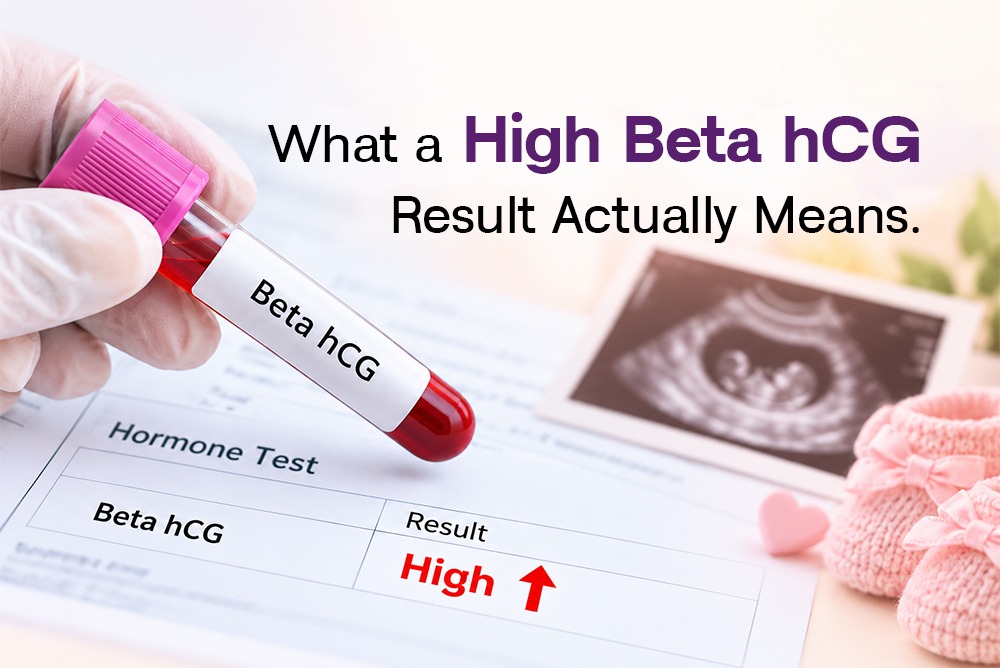
Finding out that you are pregnant is the happiest moment but comes with a long list of questions. Something like that happens when your blood test report shows high beta hCG levels. You are unsure if you should be worried or feel relieved.
The truth is, hCG levels in early pregnancy are one of the most misunderstood numbers, and one hCG number cannot tell the complete story either. The timing of the test, how the level changes, your symptoms, and ultrasound findings all help your doctor understand what is happening. This blog will help you understand what the high hCG means and when it actually needs attention.
What Is Beta hCG and Why Does It Matter in Early Pregnancy?
hCG, or human chorionic gonadotropin, is a hormone produced by the cells which implants in the uterine lining shortly after the eggs are fertilised and eventually form the placenta. It is the hormone through which pregnancy is detected. In the early weeks, hCG plays a critical role in signalling the body to maintain the pregnancy and continue producing progesterone.
The beta hCG blood test is one of the most important measures to monitor how a pregnancy is developing. Unlike a urine pregnancy test that only tells you whether hCG is present, a quantitative beta hCG test gives an exact number, which is far more useful for doctors.
Beta hCG helps doctors:
- Confirm an early pregnancy
- Monitor changes in hCG during early pregnancy
- Assess whether a pregnancy may be developing as expected
- Help evaluate symptoms such as bleeding or abdominal pain
- Guide further evaluation along with ultrasound when needed
How Do hCG Levels Change During Pregnancy?
hCG levels usually rise quickly during the early weeks of pregnancy. They generally increase through the first trimester and later begin to decline gradually.
There is a wide range of normal hCG levels during pregnancy, and two healthy pregnancies can have very different numbers at the same stage, and that’s the reason why your doctor usually looks for the overall pattern rather than focusing only on one result.
Doctors consider individual factors like how far along the pregnancy is, the initial beta hCG level, how the level changes over time, check upon your symptoms, and look for your ultrasound reports.
How Fast Should hCG Rise in Early Pregnancy?
For a healthy pregnancy, hCG levels should double every 48 to 72 hours, especially during the initial weeks. Your doctor looks at this doubling pattern of the hCG levels while assessing your pregnancy because the rate at which hCG increases is more important than the actual number on the report.
Around 8 to 11 weeks, hCG reaches its peak, and from then it gradually starts to decline. This drop is completely natural and does not mean something is wrong. This indicates that the placenta has developed and is becoming more self-sufficient to support the pregnancy. By the time you reach the second trimester, the hCG stabilises and remains at a lower level for the rest of the pregnancy.
What Does It Mean When hCG Level is Higher than Expected in Early Pregnancy?
When your beta hCG levels get higher than the expected range, it does not always signal a problem. There are several common explanations for why it happens, where some are reassuring while others need follow-up.
- Your pregnancy may be more advanced than you think
Gestational age is calculated from the first day of your last menstrual period, but ovulation timing varies. If you ovulated later or earlier than average, your dates may be off by a week or more. A different gestational age could explain a reading that looks unexpectedly high. - It could be a twin or multiple pregnancy
Twin pregnancies tend to produce higher hCG levels because placental tissue produces more hormone. At 6 to 7 weeks, a twin pregnancy usually shows significantly higher levels. However, an ultrasound is needed to confirm the twin pregnancy. - It may indicate a molar pregnancy
In a molar pregnancy, the hCG level rises much higher and much earlier than expected because the abnormal tissue grows inside the uterus instead of a normal placenta. This is a rare condition, and it needs prompt medical attention and is diagnosed through ultrasound and hCG monitoring together. - It could reflect normal variability
Sometimes, a high hCG simply reflects the natural variation between individuals. Some women produce more hCG than average in a normal, healthy pregnancy. A single high reading is rarely a cause to worry about because it is the pattern over time that matters.
What Does a High hCG Mean After IVF?
If you have undergone IVF or IUI treatment and your reports show a higher beta hCG level than expected, then it usually suggests a twin pregnancy, especially if two embryos were transferred. Otherwise, it simply reflects strong implantation. Your fertility team will check your beta hCG usually around 10-14 days after the embryo transfer. They will closely monitor the doubling pattern over the next few tests before moving to an early ultrasound.
When is a High hCG Level a Cause for Concern?
Usually, high hCG levels are normal during initial pregnancy progression, but doctors may want to investigate further in certain situations like:
- hCG is extremely elevated for the gestational age with no clear explanation
- hCG is rising faster than expected and is accompanied by severe nausea, vomiting, or abdominal pain
- An ultrasound does not show a normal intrauterine pregnancy at the expected time
- There is a history of molar pregnancy in the past
In such situations, a doctor may combine hCG monitoring with an early ultrasound and possibly progesterone levels to get a complete picture.
Common Symptoms When hCG Is High
Higher hCG levels simply indicate early pregnancy symptoms, which means that the hormones are active. When hCG is higher, women usually show these symptoms:
- Nausea and vomiting
Morning sickness is directly linked to rising hCG levels. More hCG often means more nausea - Breast tenderness
Hormonal sensitivity can be heightened - Fatigue
Elevated hCG can contribute to tiredness in early pregnancy - Frequent urination
It is also influenced by rising hormone levels
Note: You need medical evaluation if you are experiencing extreme nausea and vomiting to the point of not being able to keep food or water down. This condition is called hyperemesis and is more common when hCG levels are particularly high.
What Does Slow-Rising hCG Mean?
If your report shows a slower-than-expected rise in hCG, then it is often linked to a pregnancy that is not developing normally. It could also be a sign of early pregnancy loss or ectopic pregnancy. If your hCG is rising slowly and an ultrasound does not show a pregnancy inside the uterus when expected, your doctor may recommend further tests or urgent evaluation. Seek medical care immediately if you have severe abdominal pain, heavy bleeding, dizziness, or fainting.
How Can Ekam Fertility & Women Help You Monitor hCG During Pregnancy?
Whether your beta hCG is higher or lower than expected, Ekam Fertility & Women is always there to help you understand what your result means. Whenever required, our team may repeat beta hCG tests, early pregnancy ultrasounds, and other assessments to closely monitor your pregnancy and address every concern early.
Under the guidance of Dr. Nischala Reddy, Ekam Fertility & Women provides personalized fertility and pregnancy care in Kokapet, Hyderabad. If you are looking for the best gynecologist in Kokapet, Hyderabad, or need expert care for early pregnancy and hCG concerns, consult Ekam Fertility & Women for clear guidance and confident pregnancy care.