Introduction
Many women want to have children, but it is not the right time for them due to various reasons, like career plans, personal priorities, or dealing with certain medical treatments. Meanwhile, they also wonder whether waiting could affect their fertility. Therefore, many women are opting for egg freezing, which allows them to store eggs and preserve their fertility for possible use in the future. This blog covers everything that you need to know about egg freezing so that you can assess if it’s an option for you.
What is Egg freezing?
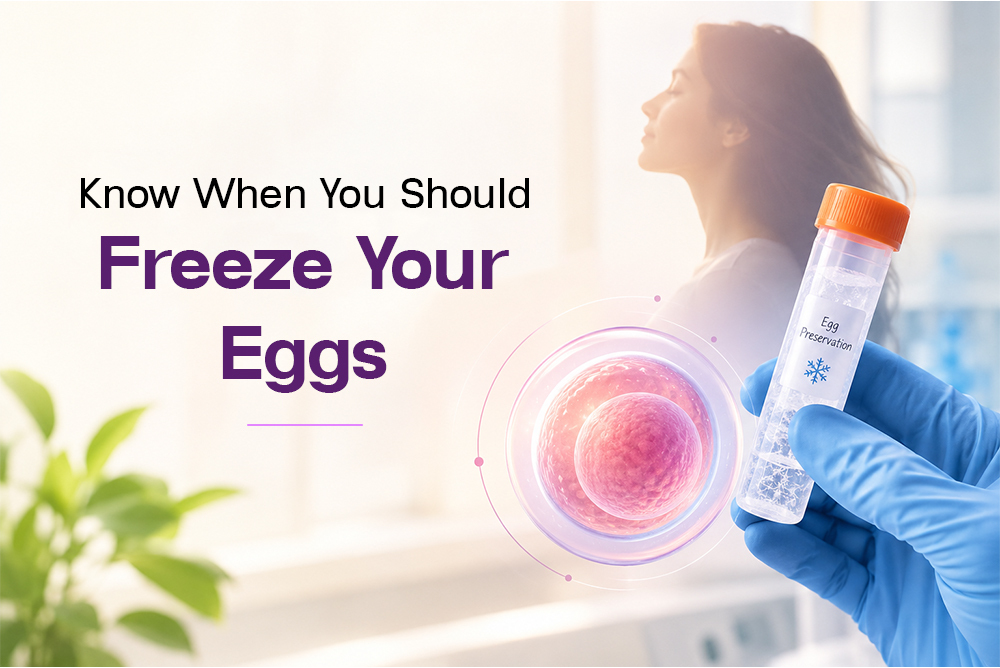
Egg freezing is also called oocyte cryopreservation. The process involves the collection of mature eggs from the ovaries and freezing them for future use. Egg extraction and freezing usually involve:
- Your doctor evaluating your ovarian reserve and overall reproductive health.
- Medicines are given for around 2 weeks to encourage several eggs to mature in one cycle.
- Then the mature eggs are collected from the ovaries through a short procedure.
- Later, the suitable mature eggs are frozen with the vitrification method. They are stored until you need to use them.
Whenever you are ready, these stored eggs are thawed and fertilised using IVF techniques to create an embryo, which is then transferred to the uterus.
Why do women consider egg freezing?
There might be medical or personal reasons why women consider egg freezing. Some women decide to freeze their eggs because:
- They might be dealing with a condition that may affect their future fertility.
- They might be undergoing medical treatments like cancer that could affect their ovarian function.
- They are simply not ready to have children but want to preserve their fertility and use their own eggs later.
- Voluntarily delaying pregnancy due to life circumstances.
Egg freezing is an option and not something that every woman needs to do. If you are confused, then it’s always recommended to have a fertility consultation to understand if it’s relevant to your situation.
What is the best age to freeze eggs?
Age plays an important role in egg freezing and fertility. As women grow older, egg quality and numbers decline, which makes it harder to retrieve a good number of mature eggs and can affect future pregnancy. So, freezing eggs at a younger age has a better chance of being useful in the future. However, there’s no single age that’s considered perfect.
And similarly, there’s also no fixed number of eggs that would guarantee future pregnancy. The number of eggs you want to preserve depends on your age and ovarian reserve. Younger women usually need fewer eggs to achieve success than someone who is freezing their eggs at an older age.
Does egg freezing affect fertility?
Egg freezing itself is a process that ensures the preservation of individual reproductive potential and does not affect fertility. Freezing eggs does not stop your ovaries from ageing naturally. Only the portion of eggs that are available during that cycle are extracted.
Egg freezing is meant to preserve and retain the properties and characteristics of the retrieved eggs at the age they were frozen, but the biological ageing of the body naturally continues. However, the success rate of future pregnancy depends on the uterus’s health so that the developed embryo implants and pregnancy continues. Along with reproductive health, the frozen eggs need to survive thawing and must be fertilised.
What are the limitations of egg freezing?
Egg freezing is generally considered a safe fertility-preservation procedure, but it still involves medicines and an egg-retrieval procedure. So some of the possible limitations include:
- Temporary side effects from ovarian stimulation medicines.
- Ovarian hyperstimulation syndrome (OHSS), although modern treatment protocols can reduce the risk.
- Risks associated with the egg-retrieval procedure.
- Not every egg may survive the freezing and thawing process.
- Not every egg will fertilise or develop into a viable embryo.
- Sometimes more than one cycle may be needed.
- Future pregnancy is not guaranteed.
It is also important to consider the health risks associated with pregnancy at an older age, which are separate from the process of freezing the eggs itself.
Is Egg Freezing Painful? What Type of Anaesthesia Is Used?
The egg-retrieval procedure is generally performed under sedation or short-duration anaesthesia, so you are usually comfortable during the procedure and do not experience significant pain. The exact type of anaesthesia may vary depending on your medical condition and the treatment protocol followed by the fertility centre.
The egg retrieval itself is a short procedure. After the procedure, some women may experience mild cramping, bloating, or discomfort, similar to menstrual cramps, for a short period.
The hormone injections used during the ovarian stimulation phase may also cause mild discomfort at the injection site, along with temporary bloating or mood changes in some women.
The fertility specialist and anaesthesia team will explain the procedure and the most suitable anaesthesia option for you before egg retrieval.
How can Ekam Fertility & Women help with egg freezing?
At Ekam Fertility & Women, our specialists assess your ovarian reserve, age, medical history, and reproductive plans before discussing fertility-preservation options with you.
Under the guidance of Dr. Nischala Reddy, you can understand whether egg freezing is suitable for you and what to expect from the egg freezing process. If you are looking for the best gynecologist in Kokapet, Hyderabad, our team at Ekam Fertility can help you make this decision with clear and personalised medical guidance.